

Two new reports shed light on how the 2024 Jasper wildfire spread so quickly.
The reports, which were commissioned by Parks Canada, also reaffirm the importance of FireSmart principles.
The Natural Resources Canada (NRCan) report focuses on the fire’s behaviour outside the townsite and its rapid growth between July 22 and 24, while the FPInnovations (FPI) report looks at how the fire spread within the townsite.
David Argument, resource conservation manager for Jasper National Park, said the documents speak to the effectiveness of wildfire risk reduction measures that have taken place over the last two decades. Those efforts need to continue, he said.
“We need to redouble our efforts on the wildfire risk reduction and FireSmart measures that we have recommended and that we know are the right thing to do but that can be really hard to implement, fund, resource and co-ordinate.”
Beetle factor
The NRCan report highlights the key factors contributing to the wildfire’s rapid spread south of town. One of them was the impact of the mountain pine beetle-affected forest. Argument explained how the risk was higher in 2016 when beetle-infested trees were still in their red phase, which was why Parks Canada removed over 300 hectares from Pyramid Bench west of town.
“We know [the mountain pine beetle] is a factor in the landscape,” he said. “We know that risk is higher immediately following the epidemic.”
Record heat and humidity
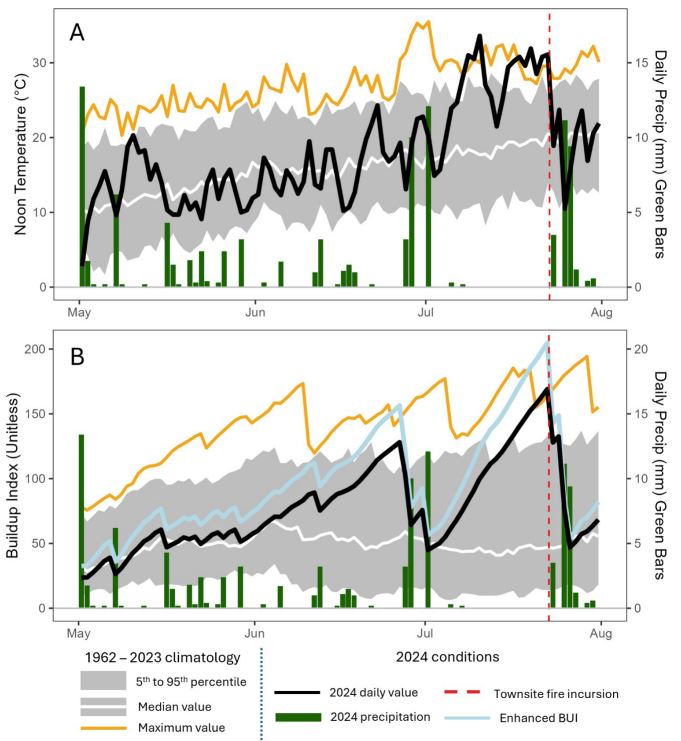
The report also noted how there were a significant number of other factors which contributed to the fire’s rapid spread, such as how July 2024 was the hottest and driest July on record.
“No daily rainfall greater than 2 mm was recorded at the Jasper Warden Station or nearby stations from July 1–22, 2024,” the report says. “Record high temperatures were recorded in the days leading up to the fire.”
During that 23-day span, the BuildUp Index (a numeric rating of the total amount of fuel available for combustion) increased rapidly to an extreme level. The BUI rating of 169 was the highest value recorded for that time of year, and above the 99th percentile for all fire season values, according the report.
Fuel treatment saved structures
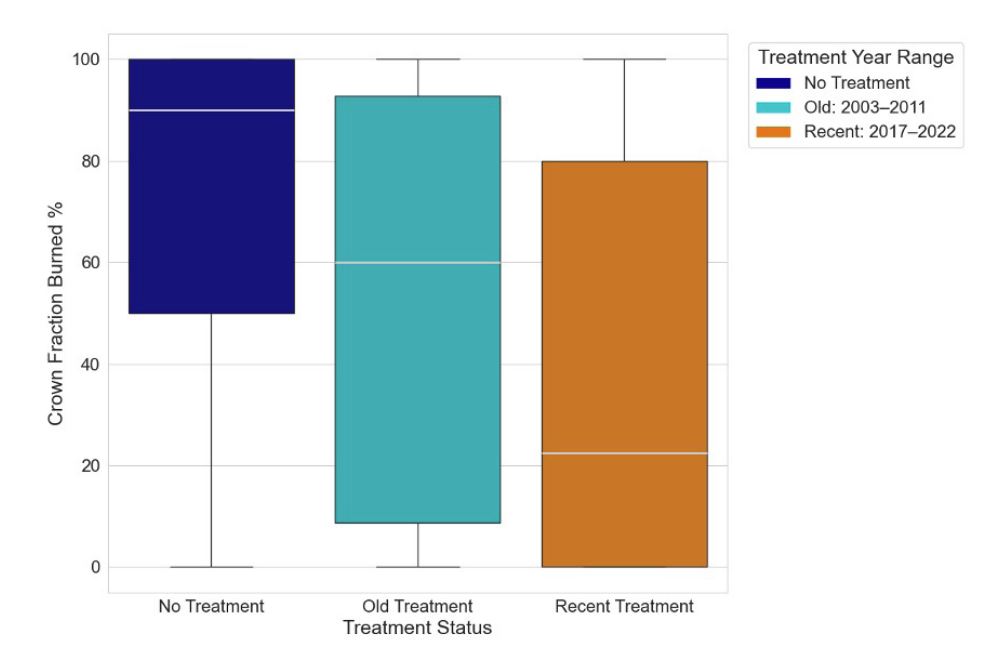
Additionally, the report credits hazard reduction treatment around the townsite since 2003 for moderating fire behaviour and likely limiting ember production and transport.
“In treated areas, fire severity, fuel consumption, and crown fire behaviour were lower compared with untreated areas, reducing the extent of sustained crown fire and consequently reducing the [rate of spread],” the report states.
Argument said this helped bring a crown fire down to the ground where it could be more easily managed and blunt the blaze’s intensity.
“It helped reduce the impact of the fire on the community,” he said. “From one perspective, this work contributed to saving 70 per cent of the community, including all the critical infrastructure.”
Last winter, Parks Canada added another 116 hectares of vegetation management adjacent to the community. Now, Parks Canada is working toward building and maintaining a 2.5-km buffer of vegetation management around town. This is not a clearcut, Argument said, but an effort to remove key wildfire risk factors through vegetation thinning, crown spacing and in some cases wholesale removal of the canopy.
Structure-to-structure ignition
The FPI report, meanwhile, details how the ember shower ignited vulnerable structures, particularly ones with combustible roofs and flammable vegetation. Once structures ignited, “closely spaced structures facilitated urban-fire spread and the development of the urban conflagration,” according to the report. There was a high likelihood of structure-to-structure ignition when the spacing was less than five metres.
Unless motor vehicles were immediately adjacent to a burning structure, they did not contribute to the threat of spread. Argument noted this led to “interesting anomalies” where relatively undamaged vehicles would be sitting in the middle of burnt neighbourhoods. “Obviously, those motor vehicles are not built out of easily combustible materials that a burning ember can take hold in,” he said.
Last year, Parks Canada worked with the Municipality of Jasper to update development guidelines to prevent new builds from using combustible materials. The next step would be looking at how to address existing structures with cedar shake roofs and deal with ongoing vegetation management issues in and around town. Argument said these reports would hopefully spur the discussion further.
The two reports come three months after the Municipality published its own report, which caused controversy for alleging the Alberta government created command challenges during the fire response. Premier Danielle Smith demanded an apology over the report.
An independent, third-party evaluation of the wildfire, being conducted by MNP LLP, is expected to conclude next spring. It will use content from the two recent reports and other sources to conduct an evaluation of the whole complex and potentially offer recommendations.
Peter Shokeir // info@thejasperlocal.com
With files from Andrea Ziegler // andrea@ravencommunitymedia.com