

Solar is for sale in Jasper. But as Jasper Local publisher Andrea Ziegler has discovered, taking advantage of the sun’s energy isn’t as straightforward as it might seem
For some years, my husband and I have been considering installing solar panels on the roof of our Jasper home.
We have been delaying our investment in solar because not only are the systems somewhat complicated, but government incentives and regulations can radically change the up-front costs and payback period. We’d love to go greener with our energy use, but it has to make economic sense.
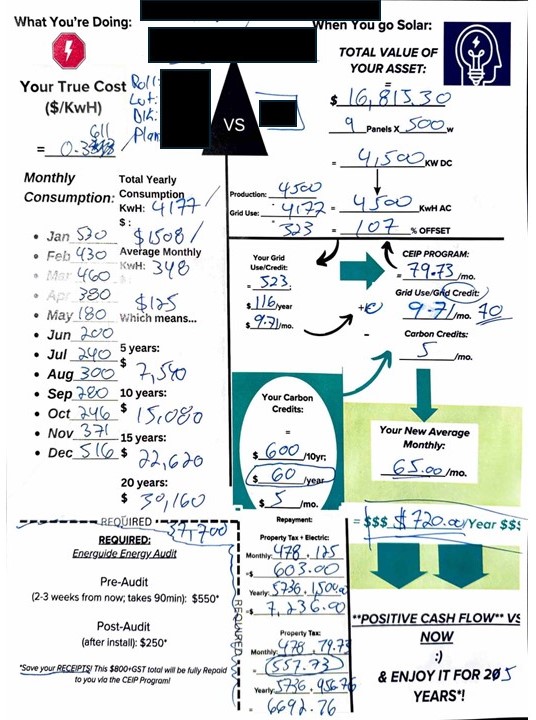
One dark December afternoon, we heard an unexpected knock on our front door. A shouted invitation from my husband to “come on in” and we were soon face to face with a door-to-door salesman. Let’s call him … Sonny.
In an apparent effort to gain our trust, Sonny was quick to drop the names of neighbours, friends, and even local elected officials—they were all enamoured by the prospect of farming the sun’s rays, he promised. His pitch was fast and furious. We were cautiously curious.
Solar incentivizing
Two programs exist in Alberta that make it a good time to consider installing solar panels. The Clean Energy Improvement Program (CEIP) is a financing program; and Solar Clubs provide homeowners with the ability to sell excess energy. These programs are independent of each other, but both are simple to access. Together, they offer strong financial incentives to install a residential solar system.
The Clean Energy Improvement Program (CEIP) is a financing program administered by Alberta Municipalities. The program offers flexible financing for the upfront costs of energy efficiency and renewable energy upgrades, to a maximum of $50,000 of capital costs and $60,000 of eligible costs, per property. Repayment is done through the homeowner’s monthly tax bill.
Applications for Jasper’s CEIP opened on December 2, 2025. Jasper’s CEIP provides financing for up to 100 percent of project costs at a fixed interest rate of three percent for up to 25 years, with the option to repay in full anytime without penalties.
Improvements that can be financed through the program include building envelope improvements (doors, windows and insulation); HVAC (heat pumps and high efficiency furnaces and boilers); renewable energy (solar, solar thermal water heating and battery energy storage); energy-efficient water heating systems; and energy-efficient lighting fixtures and controls.
While most municipalities require occupancy of the property for at least six months prior to applying for the program, clean energy upgrades for homes rebuilt after the 2024 Jasper wildfire may be eligible for financing, according to CEIP.
Alarm bells
Applying for the CEIP is straightforward. What’s not so cut and dry is our discovery that solar salespeople appear to be using the CEIP application process as a lead generation tool. The CEIP expressly forbids third parties to complete and submit an application on a homeowner’s behalf, so when Sonny gathered our information and then turned his computer to us to click on “submit,” alarm bells were going off.
“Exercise caution when responding to advertisements or sales representatives,” the CEIP program manager told me. “Particularly those that ask you for personal information or guarantee financing or energy savings.”
After Sonny left, I contacted the CEIP and had his version of our application deleted, to ensure that he did not have access to our information.
Salespeople don’t work for free
That wasn’t the only red flag. Given the repeated mention of one, and only one, Edmonton-based solar installer, I was quite sure where our “best” quote was going to come from. Whether Sonny was earning a referral fee or a commission, I’m not sure.
What I do know is that the additional cost will ultimately be paid by the homeowner.
For the record, Alberta Municipalities recommends that property owners get quotes from multiple contractors—this is not a requirement of the program, however; only the quote from the contractor the property owner has selected to do the work needs to be included with the application form. But to be eligible for financing, installation must be completed by a CEIP qualified contractor.
(Engaging a reputable solar broker may be a way to get multiple quotes. They typically work on a five percent commission basis and will provide a breakout between the multiple quotes).
Join the (Solar) Club!
While attractive financing makes installing solar panels more affordable, Alberta’s Solar Club program creates the necessary conditions for a return on the homeowner’s substantial investment.
Solar Clubs allow residential energy producers to sell excess energy to select utility companies in the sunny summer months, build up credits, and then use those credits to buy electricity in the winter. Credits offset both energy purchases and fixed fees for your entire bill (electricity and natural gas), with the property owner’s ultimate goal to have zero energy costs over the course of the year.
The first step to getting started with a Solar Club is to sign up with an Authorized Energy Marketer. Currently numbering 40, these are local energy marketing companies that offer solar-friendly rates, cash back rewards and support local Alberta charities. Switching is fast and easy, with your new provider handling the transition from your current provider.
Size Matters
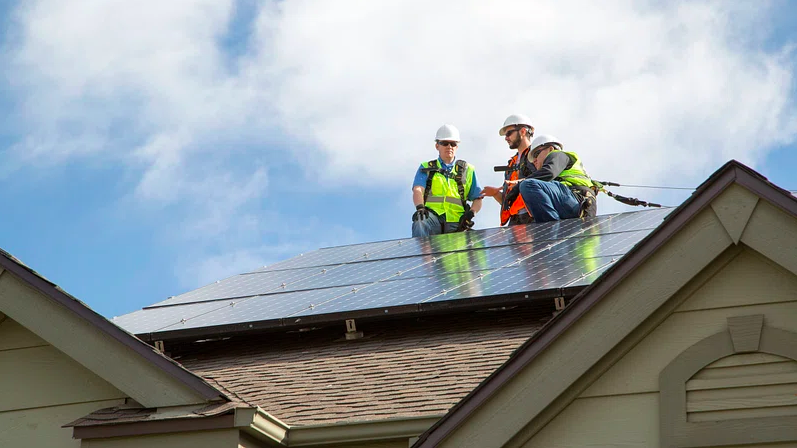
Knowing all this, clearly the solution is to cover one’s roof in solar panels, bring down the cost per installed kW, sell the excess and make some money! Not so fast. To ensure systems are used for personal consumption rather than commercial electricity generation, and to protect electrical grid infrastructure from overload, Alberta’s Micro-Generation Regulations limit solar energy production to 105 percent of a homeowner’s annual electricity needs. Licensed solar installers are required to model your system to not exceed your consumption over the previous 12-months. Disappointingly, current regulations do not accommodate forward planning for future electricity needs.
Future planning
If a homeowner is considering making changes that would significantly increase electricity consumption—for example installing a heat pump, charging an electric car or switching appliances from natural gas-powered to electric—in order to substantiate increased electricity usage and thus raise the limit on the allowable solar array, they have to show their receipts. A simpler option, we discovered, is to install the equipment, wait a few months to reflect the changes on your electricity bill, and then size your array appropriately.
Back up systems
Solar as a backup system makes sense in Jasper, where we are not exactly on the provincial power grid but rather on a spur line that is vulnerable to frequent power outages. Weather, wildfire and excessive load elsewhere on the system increase our risk of losing power. And it’s not just the inconvenience of (albeit romantic) candle-lit evenings. With respect to those who lost their homes in the July 2024 Jasper Wildfire, many Jasperites have lost the contents of their fridges and freezers twice in the past five years—not to mention having to pay for the associated damage that can occur when white appliances thaw and spoil.
If equipped with a battery back-up system, if and when the lights do go out, your home-based array will stop feeding power into the grid and your home will run directly off your array and battery. The additional cost of a battery backup setup is substantial; our first quote included an estimate of $20,000. Conversely, a natural gas generator, which would provide similar automatic cut-over when the grid goes down, runs between $8,000 and $16,000. Of course a natural gas generator doesn’t have the benefits of reducing your energy costs or reducing your carbon emissions. And unlike the sun, the gas can get shut off, as it was during the Jasper Wildfire.
Unfortunately, all of these caveats and complications weren’t explained by Sonny. Instead, his idea was to artificially inflate our energy consumption by running a space heater full-blast for a few months, thus increasing our allowable energy sales. The provincial industry group, Solar Alberta, has reported a record number of complaints this year. Shady sales tactics and fraudulent activity have become prominent as the demand for rooftop solar systems rises.
Combined with Sonny’s tenuous knowledge of the industry in general, our hackles were up, to say the least. Other Jasperites considering going solar should likewise be on guard for salespeople making sunny promises while dealing in the dark. We remain keen on installing solar energy, but not on getting scammed in the process.
Stay tuned for Part 2 of this Solar Series, where The Jasper Local will investigate considerations on sizing, calculate return on investment and include sample utility bills from residential micro-generators.
Andrea Ziegler // info@thejasperlocal.com