

A new program will allow affordable housing providers to apply for a grant that offsets municipal property taxes.
Council approved the program on Tuesday (July 7). The program will initially have $250,000 available, which is funded by a $9.4-million Housing Accelerator Fund grant from the federal Canada Mortgage and Housing Corporation.
“Housing affordability remains a significant challenge in Jasper,” said Leanne Pelletier, municipal housing manager, during the June 23 committee of the whole meeting.
“High housing costs, the impacts of the 2024 wildfire and a shortage of affordable and below-market housing all reinforce the need for practical tools that support housing development and long-term affordability.”
The program aims to lower operating costs for providers, encouraging the development and retention of affordable housing. Once launched, providers will be able to submit applications through a portal on the municipal website.
To be eligible, at least 25 per cent of a property must meet affordability requirements, and providers must either be a non-profit, partnered with a non-profit or a municipally controlled corporation. Commercial and already tax-exempt portions of properties will not qualify.
Grants will be limited to the municipal portion of property taxes and prorated when only a portion of the property qualifies.
Administration considered reduced development charges, but this mainly falls under Parks Canada’s jurisdiction, since the Municipality is still transitioning to having land-use authority.
Staff also mulled property tax exemptions, but under the ministerial order that allows municipalities to do this, affordable housing owned and operated by the Jasper Municipal Housing Corporation would not qualify.
Once the initial funding is spent, staff will reevaluate the program and return to council with recommendations.
Tennis court sponsorships
Council approved a sponsorship program to provide clarity on what the Jasper Racquet Club can promise donors for its future projects.
The club intends to repave three tennis courts and create three new pickleball courts. When presenting to council on June 16, it warned of a shortfall of $75,000 and wanted clarification around sponsorships.
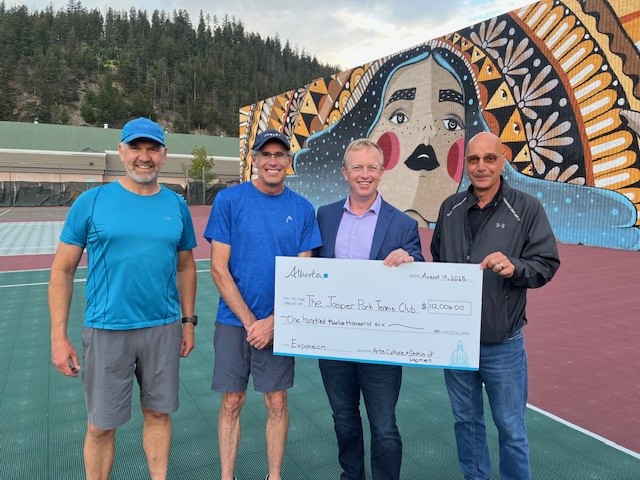
Under the new program, sponsorship opportunities will include a donor wall for $500 or more pending club approval, individual court naming rights for $25,000 or more for a 10-year term and facility naming rights for $100,000 or more for a 15-year term.
Administration must approve court names, while council will need to approve facility naming. The club remains responsible for fundraising.
Encroachment bylaw
Council gave first and second reading to a new bylaw dealing with encroachments on municipal land.
While the current policy provided a detailed framework for evaluating and managing encroachments, having a bylaw instead gives the Municipality enforcement tools.
The bylaw maintains many key elements of the policy, such as application requirements, evaluation criteria, encroachment agreements, utility review requirements and protections for municipal operations and emergency access.
When municipal resources are required to address encroachments, the bylaw allows it to recover costs from the responsible party rather than taxpayers. This can be done by adding the amount to the property owner’s tax roll or any other lawful means.
The bylaw will return to council for third reading in August.
Records retention and disposition
Council gave first to a new bylaw that gives the chief administrative officer (CAO) authority to decide how long records are retained and when they are destroyed.
Administration already handles these matters internally, but the bylaw would officially authorize the CAO to establish, approve and maintain records retention and disposition schedules. These cannot contradict provincial regulations.
Christine Nadon, director of Protective and Legislative Services, said seven years was a common retention period for most records, while certain records such as council minutes can never be destroyed.
Council requested several amendments, such as defining a municipal record and reviewing verbiage before second reading. The bylaw will return to council in August for second reading.

Borrowing bylaws
Council gave second readings to four borrowing bylaws and will need to give third readings before it can borrow the requested funds.
The bylaws authorize the Municipality to incur debts of $1.9 million for the third phase of renovating the Jasper Recreation Complex, $3.2 million for renovating and upgrading the wastewater treatment facility, $4 million for servicing wildfire-affected water and wastewater infrastructure and $776,705 for servicing Arnica Avenue.
Council has previously discussed these items in detail.
Peter Shokeir, Local Journalism Initiative // info@thejasperlocal.com