

Editor’s Note (3 p.m. Sept 15): This story has been updated since The Jasper Local learned that the outstanding taxes and penalties were paid.
The century-old Astoria Hotel has paid $644,000 in outstanding taxes and penalties. The payment occurred after council met on Tuesday.
At that meeting, Council declined to accept a $380,000 payment proposed by Astoria owner and general manager George Andrew on Tuesday (Sept. 15). Instead, it will consider a possible refund at a future committee of the whole meeting, pending receipt of the full payment.
Council also indicated it would review the Municipality’s tax penalties bylaw.
Had the hotel not paid by Thursday (Sept. 17), it would have been put up for auction.
Mayor Richard Ireland said ratepayers have abided by the bylaw since it came into effect in 2004. While he was open to reconsidering the penalties, he noted that changes to a bylaw are typically not retroactive.
“It is there for a purpose,” he said. “It is a disincentive, because we are not to treat the Municipality as a bank for people who don’t pay their taxes.”
Ireland also cautioned that the matter was a last-minute addition to the agenda, meaning members of the public did not have an opportunity to weigh in.
“We hope that an auction does not take place, and there is a way to absolutely prevent that from happening, and that is to pay the $644,000,” he said.
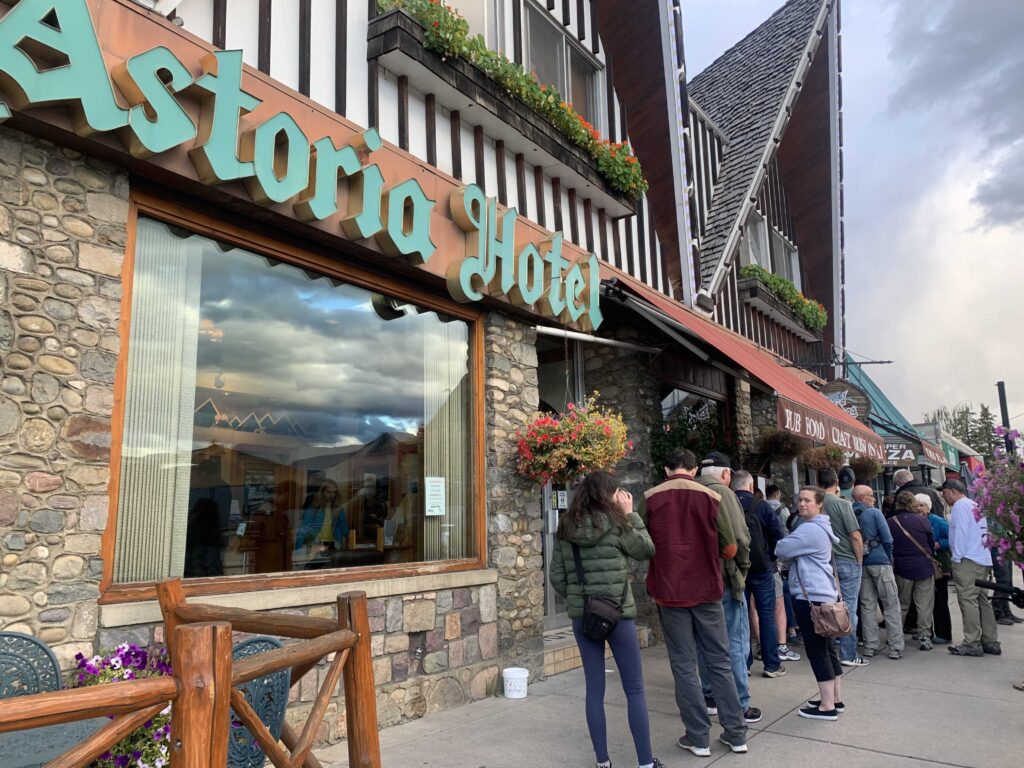
Built in 1925, the Astoria is one of Jasper’s original hotels. The Andrew family has owned and operated the establishment for four generations.
Since 2020, the Astoria accumulated more than $945,000 in unpaid municipal taxes and penalties. The business has since paid about $671,000, leaving $644,000 outstanding, including approximately $383,000 in penalties.
Andrew attributed the hotel’s financial difficulties to “the three successive economic shocks” of COVID-19, the 2022 Chetamon wildfire and the 2024 Jasper wildfire.
“As a result, the Astoria Hotel has struggled with the ability to pay all of the municipal tax bill,” Andrew told council.
He also criticized the Municipality’s compounded penalty rates.
The Municipality applies a monthly penalty of three per cent to unpaid taxes for the current year. If taxes remain unpaid after year-end, an 18 per cent penalty is applied annually to the outstanding balance.
Andrew said the compounded penalty rate amounted to 39.2 per cent and was unfair. He proposed paying $380,000 — $264,000 less than the amount currently owing — arguing that if the penalties had been limited to 18 per cent, the penalty portion would have been approximately $101,000.
CAO Bill Given later cautioned that there were some “inconsistencies” in Andrew’s calculation.
In April, council moved that the hotel be offered for sale by public auction, with a starting bid of $9.6 million. The auction will be cancelled if the Astoria pays its taxes or enters into a payment plan with the Municipality.
Last year, council approved waiving $76,787 in penalties, but that decision was conditional on the Astoria enrolling in a preauthorized payment plan by the end of 2025. It did not do so.
According to municipal staff, the hotel has only entered into a payment agreement for its 2026 taxes.
Andrew said council’s decision could initiate “a long-overdue review” of the Municipality’s tax policy and regulations and encourage a healthier tourism industry.
Coun. Kable Kongsrud expressed his “frustration and disappointment” with the situation and agreed that the penalties were too high.
“I don’t like that the Municipality charges that,” he told Andrew. “We haven’t been through something like this, and I do think this would be a good time to address it.”
Rico Damota, a former councillor, spoke as a delegation in support of the Andrew family. While acknowledging that Jasper’s tax penalties are comparable to those in other communities, he took issue with the compounding of penalties.
“Just because you can do it doesn’t mean you have to,” he said. “If anybody’s afraid of setting a precedent, maybe it might be good to set a precedent for other businesses that might be facing this down the road.”
Damota also argued that the Astoria has historically generated significant tax revenue for the Municipality and said that if the property goes up for auction, it could be purchased by “outside businesspeople.”
Ireland asked Andrew whether he was aware of the penalties. Andrew said he was aware of them but did not initially understand how the rates could compound.
Ireland later noted that property taxes are based on assessed value, which takes into account factors including income during the COVID and wildfire years.
Coun. Wendy Hall said she would support having the Astoria pay the outstanding amount before council considers a policy discussion around penalties, potentially including rebates in the future.
“That feels a bit more equitable, because we’re not changing the rules for one taxpayer,” Hall said.
Coun. Danny Frechette acknowledged council was in a difficult position and connected the discussion to the broader issue of the tax ratio between residential and commercial properties.
He ultimately supported considering a refund only after the full amount is paid and as part of a policy review.
“Clearly, I think it sends a great message that we’re not swayed by the instance that is in front of us,” Frechette said. “It will not appear as if it’s a short, knee-jerk reaction to a situation that is uncomfortable, no question.”
Coun. Kathleen Waxer said council needed to balance empathy for the individual situation with the broader public interest.
“This is far too rushed of a situation to make a decision on that magnitude,” Waxer said.
Peter Shokeir, Local Journalism Initiative // info@thejasperlocal.com