

A monumental work created at the Maligne Canyon Tea House offers a connection between Jasper, an Indigenous Canadian art icon and a family that helped preserve his legacy.
More than four decades ago, Norval Morrisseau carried his paints into a small studio above the Maligne Canyon Tea House.
In time, he would begin working on an extraordinary, 22-foot long, 10-foot high canvas.
This week, as Canadians mark the National Day for Truth and Reconciliation, that monumental painting is hanging in the Thunder Bay Art Gallery—back on public display for the first time since 1986.
For Joseph Helmy, whose father Galal Helmy hosted Morrisseau at the tea house and became his friend and patron, the painting represents something larger than a remarkable piece of Canadian art.
“If I could sum it up into one word, it would be unity,” Helmy said.
The painting was created during Morrisseau’s 1985–87 period in Jasper, and remained in the Helmy family’s private collection for approximately 40 years. It is now the centrepiece of Morrisseau Masterwork, an exhibition running at the Thunder Bay Art Gallery through Jan. 3, 2027.
The Thunder Bay Art Gallery describes the work as a 22-by-10-foot Woodland-style mural depicting a gathering of human figures, children, animals, birds and spiritual beings among natural elements. It arrived at the gallery as a rolled, raw canvas and was stretched and installed for the first time in a formal gallery setting.
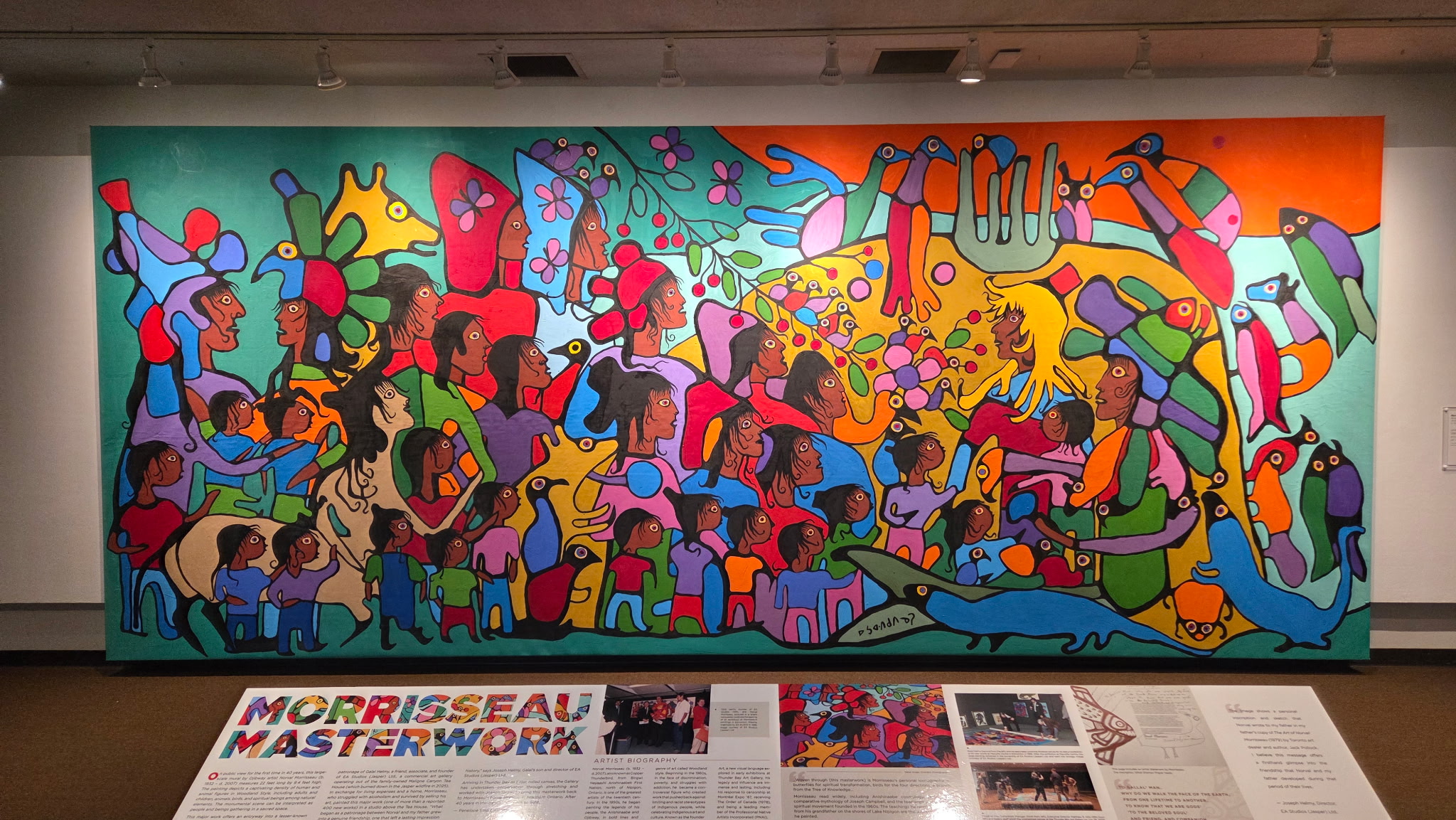
Bob Gravelle, the gallery’s MarComs coordinator, said seeing the painting fully installed was an emotional experience—even for staff accustomed to working with major Morrisseau pieces.
“You get some sense of size of these things when you’re looking down on them,” Gravelle said. “But to have that piece take up that space [on the wall] and have it loom over you is nothing short of breathtaking.”
Staff were cheering when it went up, he said.
A Jasper beginning
The story of the painting begins in Jasper, where Morrisseau lived and worked at the Helmy family’s Maligne Canyon Tea House during the mid-1980s.
Galal’s son Joseph was born in 1987 and doesn’t remember Morrisseau’s Jasper residency firsthand. His memories come largely through his father, who remained deeply affectionate toward the artist.
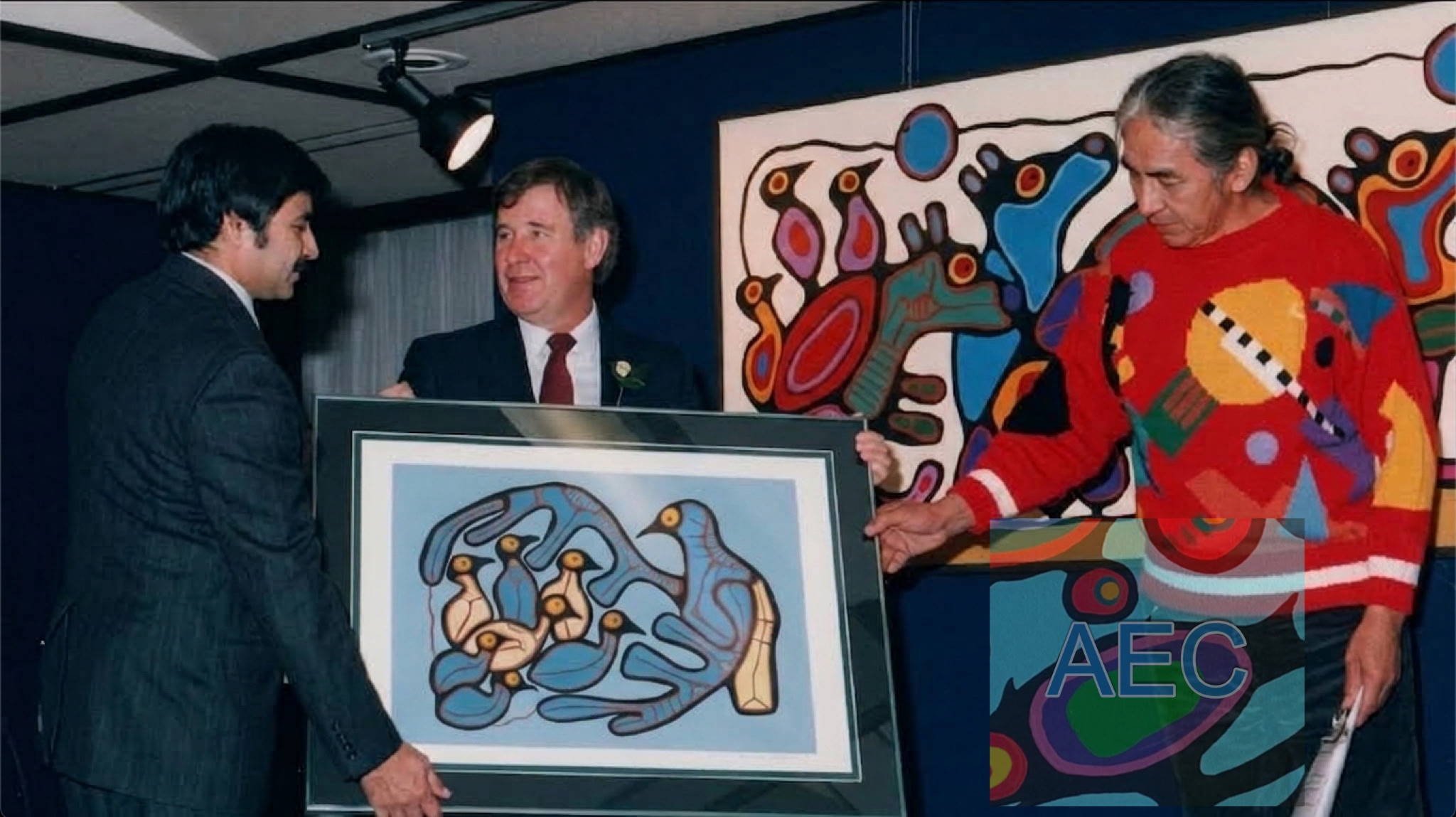
The relationship started when Morrisseau was looking for sponsorship in the mid-1980s. A Manitoba gallery owner who had previously sold a Morrisseau painting to Mr. Helmy recommended that the artist contact him.
When he did, as the story goes, Morrisseau said, “‘Mr. Helmy, I have a dream I’m painting for you in the Canadian Rockies,’” Joseph recalled.
Mr. Helmy was sufficiently taken with the idea that he promptly booked Morrisseau on a flight to Edmonton. He picked up Morrisseau at the airport, stopped at an art supply store, and took him to Jasper, Joseph said.
“He was smitten,” Joseph said of his dad’s reaction to Morrisseau. “He was taken with him.”
Morrisseau settled into the tea house during the quieter months, after the busy tourism season was over. Helmy said his father would visit the artist almost daily, bringing whatever supplies he needed.
“My father wanted to make him comfy,” Joseph said.
The arrangement gave Morrisseau a place to work, surrounded by the mountains he had come to appreciate. Helmy believes the environment brought a sense of peace to the artist, something he believes can be seen in the care and attention Morrisseau gave to the works he created during the period.
An artist who built bridges
Morrisseau, who died in 2007, is widely regarded as the grandfather of contemporary Indigenous art in Canada. Gravelle said his influence can be seen in generations of Indigenous artists who followed him.
But Helmy said his father’s understanding of Morrisseau went beyond his status as an Indigenous artist.
Morrisseau wanted to be recognized as an artist first, Helmy said, while also using his work to bring Indigenous and non-Indigenous people together.
“He didn’t use words. He used art,” Helmy said. “One of the things that Norval was very adamant about was that he wanted to be recognized as an artist first above being an Indigenous artist.”
For Helmy, that makes the giant canvas particularly appropriate to display on the National Day for Truth and Reconciliation.
In remarks he delivered at the Thunder Bay Art Gallery, Helmy said his family had come to understand that Morrisseau’s work was intended to build bridges between Indigenous and non-Indigenous people.
“They’ve invited us to look, listen, learn and find connection across cultures,” he said.
He sees the painting as part of a shared Canadian story.
“Whether our families have lived on this land for countless generations, whether we were born here or whether we choose Canada as our home, Morrisseau’s work belongs to our shared Canadian story,” Helmy said.

A day for reflection
The timing of the Thunder Bay exhibition was not deliberately chosen to coincide with National Day for Truth and Reconciliation, Gravelle said. But the gallery sees the themes as inseparable from its broader responsibility.
“The timing was happenstance,” Gravelle said. “But these kinds of things are always important to us, at all times.”
On Wednesday, Sept. 30, the gallery is offering free admission, providing visitors with an opportunity to reflect and learn. Gravelle said creating space for education, connection and reflection is part of the gallery’s responsibility to its community.
For Jasper residents, the exhibition offers another connection: a piece of the town’s own history has travelled more than 3,000 kilometres to the place where Morrisseau was born.
And for Helmy, the journey isn’t necessarily over.
After the Thunder Bay exhibition closes in January, he said the family intends to take the work east before eventually bringing it back west. A return to Calgary—or potentially Jasper—is part of a five- to 10-year plan.
For now, though, the painting is doing what Helmy believes Morrisseau intended his art to do: bringing people into the same room, asking them to look, listen and find a connection.
Bob Covey // bob@thejasperlocal.com