

Jasper is exploring ways to dispose of the biosolids sludge generated by its wastewater treatment plant, with three options under consideration carrying estimated costs of $7.9 million to $11.9 million over the next 15 years.
On Nov. 10, committee of the whole directed administration to develop implementation plans for the three highest-rated options and bring them back to a future meeting.
Of 11 options evaluated, the top three were landfill burial, modular low-temperature heat-pump drying and using the biosolids for reclamation at mine sites.
Landfill burial would cost an estimated $7.9 million over 15 years, or about $659 per tonne annually, with capital costs of $2.3 million.
Thomas Ziegler, an engineer and project manager with Associated Engineering, said burial offers more predictable costs given the Municipality’s historical use of the method, although further analysis is needed to properly assess the advantages and disadvantages of each option.
Maintaining the status quo would effectively mean choosing burial, Ziegler said. The existing facility at the Jasper Waste Transfer Station has reached the end of its life, and the Municipality would need to renew its agreements with Parks Canada to continue using it.
“It’s very important that we understand that we don’t get to walk away from all costs,” Mayor Richard Ireland said.
Heat-pump drying would cost an estimated $9.6 million to $11.9 million over 15 years, or $800 to $990 per tonne annually, with $3.3 million to $4.3 million in capital costs. The process would take place on-site, drying the material to make it easier to store and transport elsewhere.
Using biosolids for reclamation would cost an estimated $11.9 million, or $950 per tonne annually, with $2.3 million in capital costs.
Ziegler said the implementation study would include discussions with potential stakeholders, including a coal mine south of Hinton where the biosolids could be used for reclamation. The Municipality could potentially receive compensation under that arrangement.
Municipal director of Operations and Utilities Courtney Donaldson emphasized that the estimates are not quotes or budgets, nor does the motion approve a project. It authorizes staff to develop plans so council can better compare the options before making a decision.
Coun. Laurie Rodger questioned why Jasper was hauling material out of town.
“It seems crazy to me that we’re shipping stuff away out of town in trucks.”
Ziegler said Banff transports its biosolids to Penhold for treatment, while Hinton has its sewage treated at the local pulp mill. He added that heat-pump drying could be advantageous in a “regionally constrained environment” like Jasper.
The options were assessed based on advantages, challenges, feasibility, environmental impact, cost and climate resilience. Ireland suggested increasing the weighting of cost to 40 per cent of the evaluation, from roughly one-sixth, arguing the financial implications would ultimately affect utility bills.
“These are big numbers,” he said. “It’s going to be reflected in the capital portion of utility bills, I presume, ultimately, and we should be cost conscious.”
The remaining 60 per cent would be divided among the other evaluation criteria.
The motion passed 5-2, with Couns. Rodger and Danny Frechette opposed. Rodger had proposed increasing cost’s weighting to 50 per cent, but the amendment was defeated 3-4.
Staff will proceed with developing plans for the original three options, regardless of the proposed changes to the evaluation criteria.
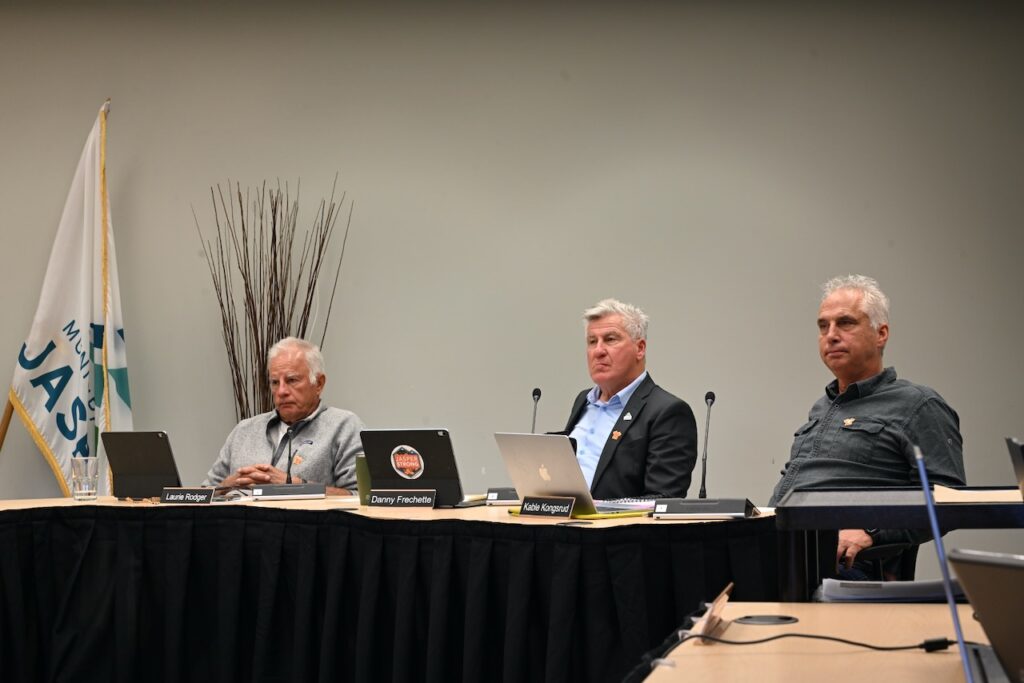
Coun. Kable Kongsrud asked whether Parks Canada would contribute to disposal costs, noting the agency paid for the original facility and visitors generate much of Jasper’s wastewater.
Donaldson said Parks Canada was involved in the initial stages of the study and that the Municipality would discuss cost-sharing once the options had been further explored. The Municipality also collects fees from hotels and dumping fees from Parks Canada.
CAO Bill Given added that council should consider biosolids disposal costs when setting utility rates.
Peter Shokeir, Local Journalism Initiative // info@thejasperlocal.com