
logo
  • News
    • Community
    • Local Government
    • Sports
    • Alberta Politics
    • Opinion
    • Obituaries
  • Jasper Builds
  • Peaks & Valleys
    • Wildlife
    • Hiking and Climbing
    • Biking
    • Fishing
    • Snow Sports
  • Culture
    • Jasper Arts & Culture
    • Local Dining
    • Local Literature
  • Jasper History
  • Support
    • News
      • Community
      • Local Government
      • Sports
      • Alberta Politics
      • Opinion
      • Obituaries
    • Jasper Builds
    • Peaks & Valleys
      • Wildlife
      • Hiking and Climbing
      • Biking
      • Fishing
      • Snow Sports
    • Culture
      • Jasper Arts & Culture
      • Local Dining
      • Local Literature
    • Jasper History
    • Support
Muskrat love (Or: a rat by any other name…)
Despite being targeted by trappers for four centuries, muskrats continue to thrive in Canada. // Mark Bradley, Boreal Nature Photography
Environment, News, Wildlife
By Mark Bradley, Freelance contributor
Friday, November 21, 2025
Muskrat love (Or: a rat by any other name…)

I Smell a Rat!

Let’s get one thing out of the way right now – muskrats (Ondatra zibethicus) are not rats.

Muskrats and rats are both rodents, but muskrats are actually more closely related to the meadow voles you can see scampering about in Jasper’s wet meadows… Muskrats are in the family Cricetidae, while rats are in the family Muridae… so to use a family analogy, you could say that muskrats are like cousins to rats, rather than siblings.

Less rat, more vole…all muskrat. // Mark Bradley

What’s in a Name? A Muskrat, by Any Other Name, Would Smell as Sweet…

So they’re not rats, but are they musky? In other words do they smell bad? Well, coming from a biologist: a bit, but not so much that you’re going to notice. Like most mammals, muskrats are highly attuned to the world of odours, and they can send a message though smelly gunk produced by a pair of glands at the base of their tails. What they are communicating is mostly ‘stay away’ to other muskrats. Both sexes will produce this ‘musk’ to mark their territories, but during mating season the male’s glands increase in size and their musk output also increases and gets smellier. And they don’t just wage war through their stink; they also engage in actual fights for the hand of those fair muskrat maidens. 
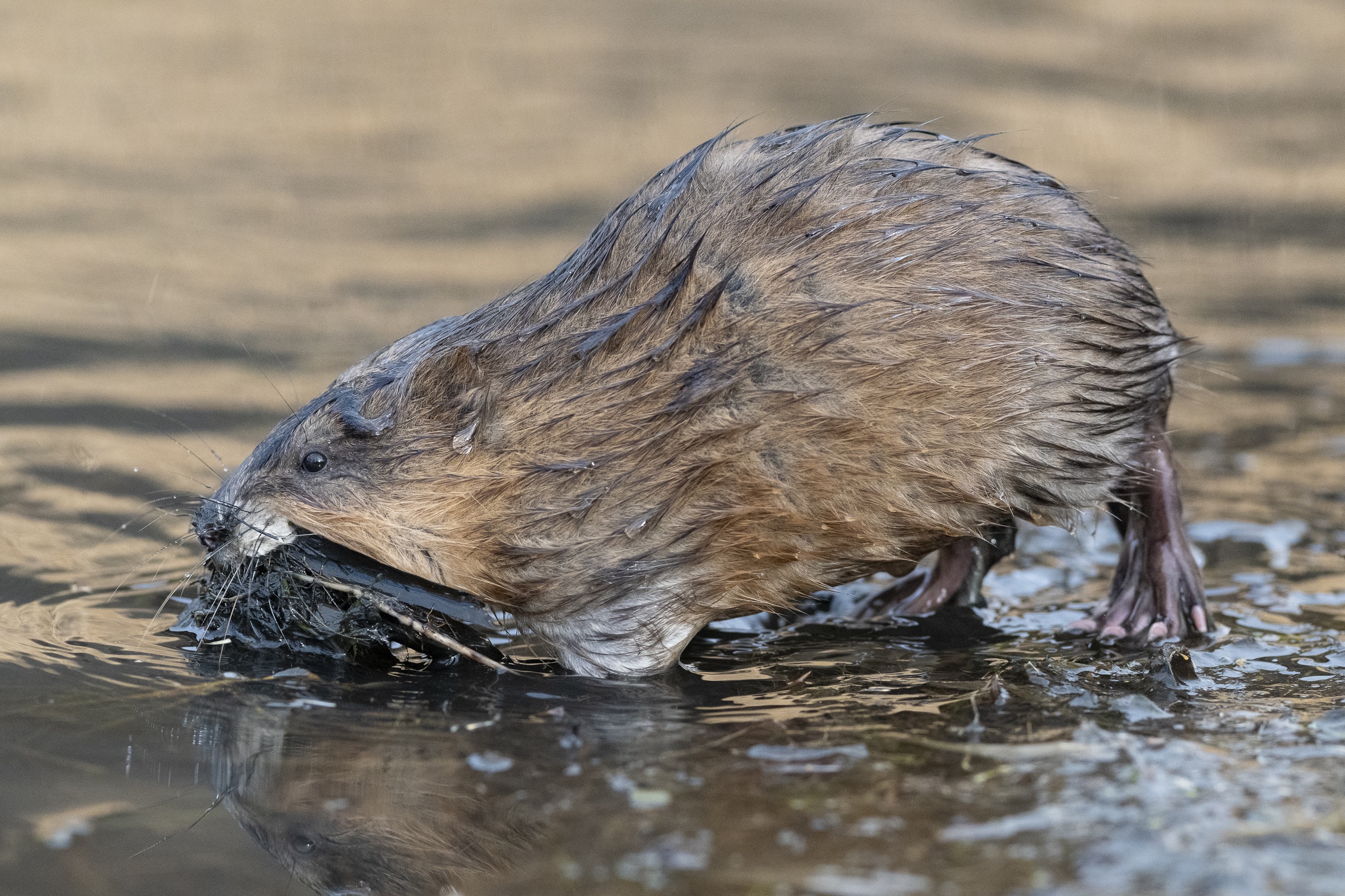
Those long hind legs and big feet are ideal for swimming. // Mark Bradley

So, if they aren’t rats, and they aren’t particularly musky, where did the name come from?

It’s not known for sure, but perhaps from the Algonquin word muscascus, meaning ‘it is red,’ because of their reddish brown fur. Their name may also come from the Abenaki word for muskrats, moskwas. The Abenaki (like several Indigenous groups) credit the moskwas for helping create the continents. Their creation story is that the planet was once all water, and various animals tried to dive to the bottom of the ocean to bring back mud, but only the muskrat succeeded.

A supernatural being (Nanabush is one name) took the muskrat’s mud and placed it on the back of a turtle, which then began growing and became Turtle Island, or what we call North and Central America.

It’s a Lifestyle

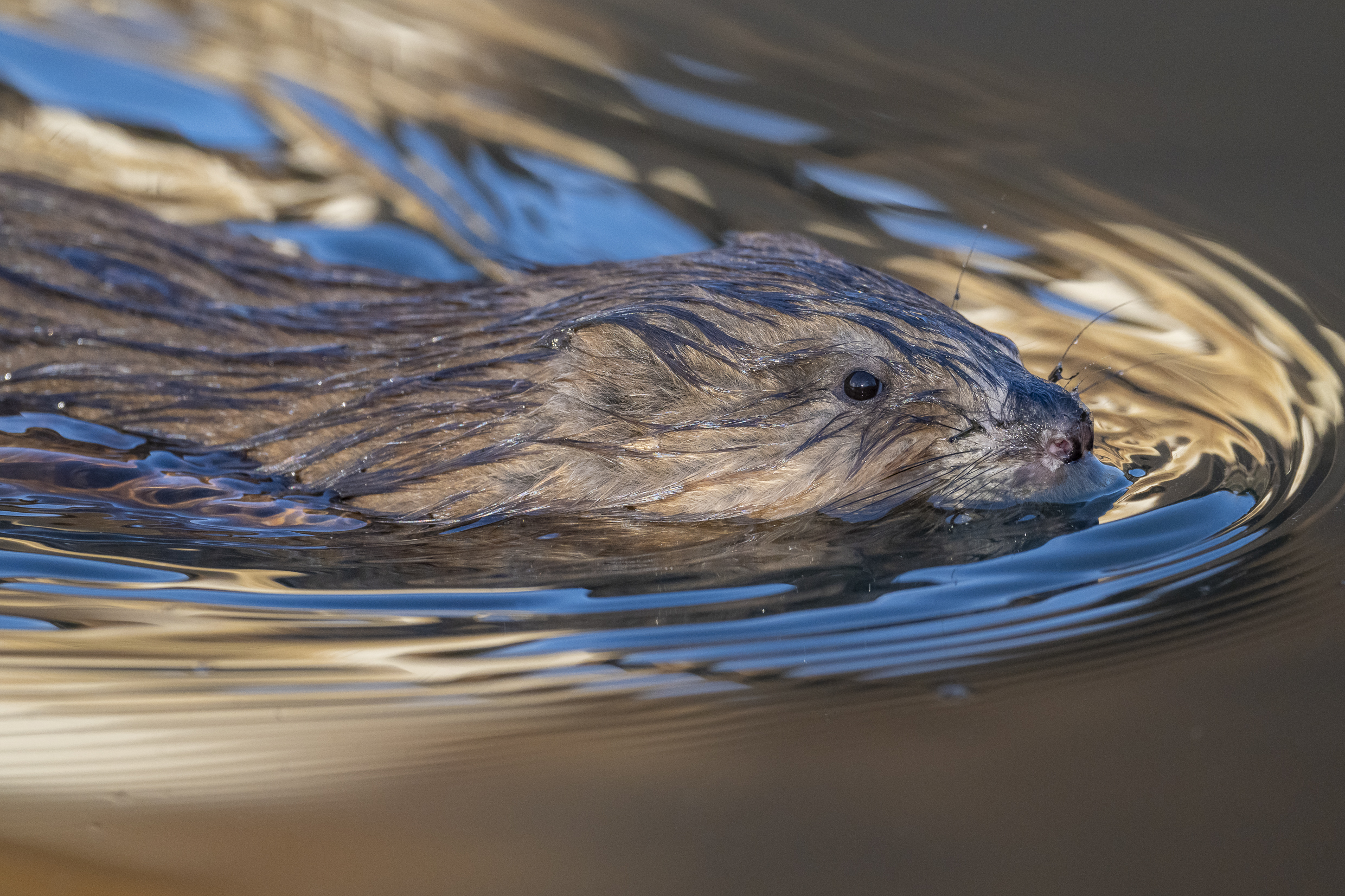
Muskrats live an almost entirely aquatic life in freshwater ponds and rivers. Native to North America, but introduced into Eurasia, they are strong swimmers, using their large, powerful back legs and webbed feet to propel them through, or on top of, the water.
Mark Bradley photo

Their back legs are so large that on land, they sometimes look like chubby little kangaroos. They mostly eat the leaves, stems and roots of aquatic plants, but will occasionally take critters like crayfish, insects, fish and frogs. Cattails are one of the most popular items on the muskrat menu. 

Like their fellow rodents, beavers, muskrats often build lodges out of mud and vegetation in the water. These lodges can be up to three feet tall and will have a dry ‘room’ or two inside—although the entrance is always underwater. Alternatively, they will dig tunnels in the riverbanks or pond edges that can be up to 15 feet long, with a room or two at the end. Muskrats will also build several ‘pushups’—a kind of mini-lodge made of mud and vegetation. These pushups serve as a kind of way-station for winter foraging trips under the ice. 

Within these dens or burrows the female muskrats bear their young. They can bear up to six young at a time, and may produce three litters per year. High reproductive rates like these probably contribute to the population cycles that muskrats go through in some parts of their range; every eight or nine years muskrat numbers will peak, followed by a crash.

Beaver or muskrat? The narrow tail of the muskrat is the give-away. // Mark Bradley

And what do muskrats do in the depths of winter? Well, they mostly wile away those winter nights below the ice or in their lodges. They don’t hibernate, so they still have to eat. A lot of their favourite foods like cattails are still available to them under the ice, in the form of roots. They have even evolved the ability to close their lips behind their front teeth so that they can bite and chew below the surface without getting a mouthful of water.

Leave it to Beaver

Muskrats often share habitat with that other wet rodent – the beaver. They look similar, and they do similar things, but muskrats are not closely related to beavers. So how do you tell them apart? For one, beavers are much larger than a muskrat. An adult beaver can reach 60 pounds, with the record-holder weighing in at 100 lbs! A big muskrat, on the other hand, is only about five pounds. Telling them apart in the water can be difficult in poor light or at a distance because you may only see the head of a beaver as it glides along the surface of a pond—and that head can look like an entire muskrat! If you see the skinny tail, however, you’ll know you’ve got your muskrat.

The Fur Trade

Muskrats have been a mainstay of the Canadian fur trade for at least 400 years. Millions of muskrats have been trapped over the centuries, and that industry continues today: in 2021 more than 81,000 muskrats were trapped so that we can make hats and coats out of their warm, insulating fur. While this seems like a lot, the consensus seems to be that the trapping industry is not causing big declines. Muskrats high reproductive rate probably has something to do with that. And remember when I said that muskrats don’t smell all that bad? Well, they sure do if you’re skinning one and puncture one of those musk glands—that’s perhaps why the ‘musk’ part of their name stuck. 

Do Muskrats Need Some Love?

Ok, I know what you’re thinking. These info tidbits about muskrats are all very well, but what about the 1976 Captain and Tennille hit ‘Muskrat Love’? For those of you who weren’t around in 1976, this was a chart-topping hit in the US and Canada, and it really was about a fictional muskrat couple that was deeply in love. The song even included a keyboard solo that, according to “The Captain” himself, was meant to represent the sounds of muskrats mating. While I usually like to defend the music of my youth, in this case…I cannot. 
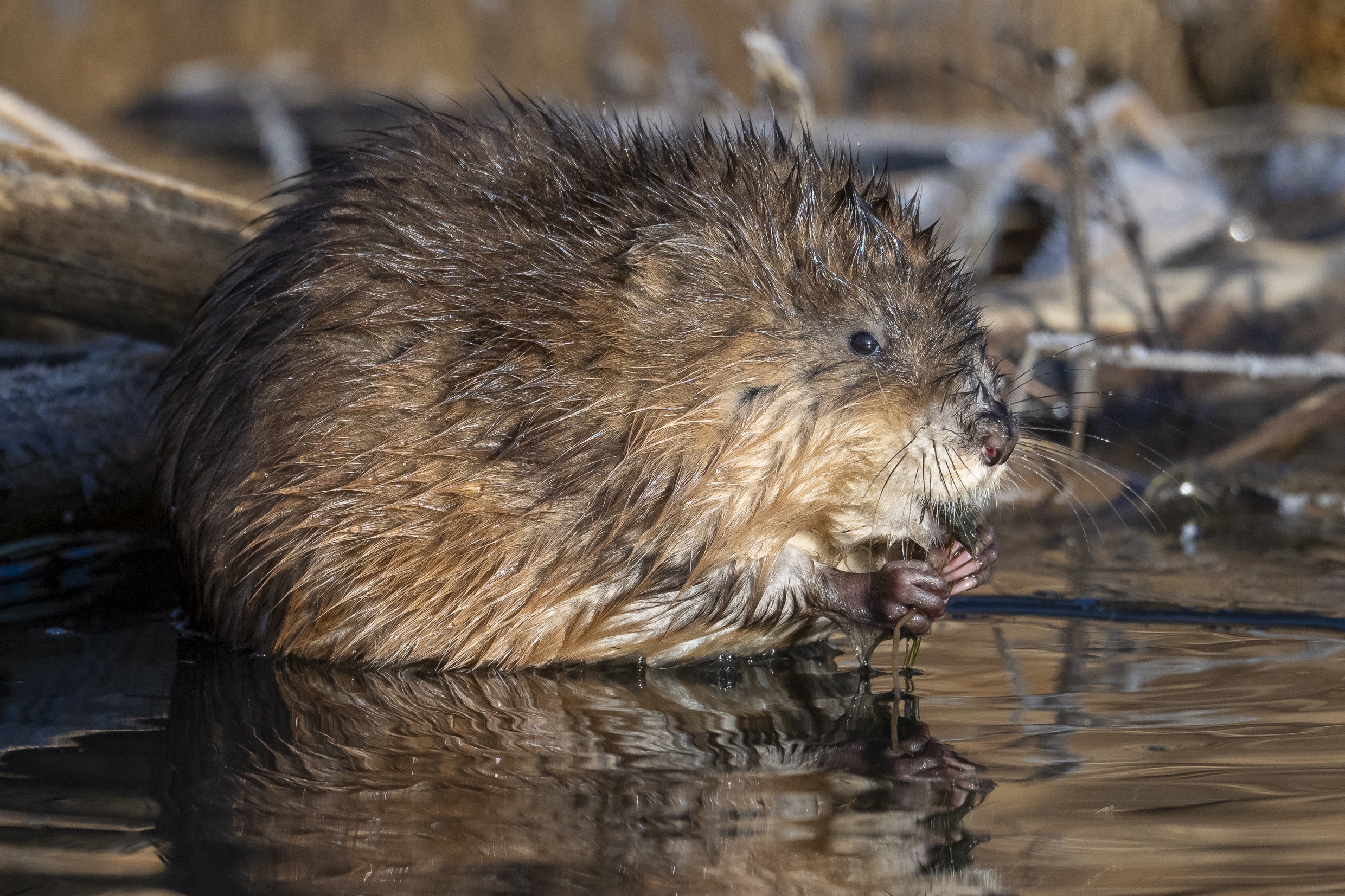
“And they whirl and they twirl and they tango… Looks like muskrat love.” From the hit song ‘Muskrat Love’ by The Captain and Tennille, 1976. // Mark Bradley

Muskrats are mostly fine in Canada (except perhaps in the Peace-Athabasca Delta of Wood Buffalo National Park, where long-term changes to water levels have rendered much of their former habitat unusable). In the US however, there have been widespread and drastic declines in muskrats: muskrat populations have declined by at least 50 percent in 34 states. In a few states the decline ha been catastrophic—more than 90 percent.

Researchers have studied numerous possibilities for the cause of these declines. Trapping kills a lot of muskrats but there seems to be a consensus that it isn’t the smoking gun here. Similarly, it seems that disease and pollution are also not dire enough to be the culprits. Although the puzzle has still not been conclusively solved, perhaps the changes to water levels are also at play in the US. 

If the ponds and waterways that the muskrats depend on are eliminated, so too are the muskrats. One thing is for sure – muskrats have no problem living near people as long as we supply them plenty of small water bodies to live in.

Perhaps it’s time for us to show the muskrats some love!


Mark Bradley // info@thejasperlocal.com

Articles You May LIke ›
New year, same dismal chance of Alberta caribou recovery
Alberta Politics
New year, same dismal chance of Alberta caribou recovery
Mark Bradley, guest contributor 
Thursday, January 22, 2026
GoA's South-Athabasca sub-regional plan represents another nail in the caribou coffin Alberta’s caribou are once again taking a back seat to industry....
this is a test
Who’s the MCBOAT? (Most Christmassy Bird Of All Time)
Community
Who’s the MCBOAT? (Most Christmassy Bird Of All Time)
Mark Bradley, guest contributor 
Wednesday, December 24, 2025
Jasper Local readers are worldly enough to know the biggest bird on earth (ostrich), as well as the the smallest (bee hummingbird ). Most know the the...
this is a test
Turning Eighty—La Fin Du Monde?
Hiking and Climbing
Turning Eighty—La Fin Du Monde?
David Harrap, guest contributor 
Tuesday, November 25, 2025
God, I was tired. And we still had to hike out. The author on a Mount Christie expedition in 2005, around the same time he celebrated his 60th year. /...
this is a test
CWD: A Zombie Deer apocalypse?
Environment
CWD: A Zombie Deer apocalypse?
Mark Bradley 
Sunday, November 9, 2025
Beware the ‘Fawn of the Dead’: a herd of skeletal, pock-marked deer limp menacingly towards their target, moaning, intent on a gory brain feast…grraaa...
this is a test
Most Read ›
Paddlers lose iconic run amid fears for Fraser fish stocks
Environment
Paddlers lose iconic run amid fears for Fraser fish stocks
Bob Covey 
Friday, May 15, 2026
A sudden ban on watercraft and wading gear in Mount Robson Provincial Park has sent shockwaves through the Jasper and Valemount paddling communities. ...
this is a test
Rotary Fire Relief Fund delivers $140K to Jasper community groups
Community
Rotary Fire Relief Fund delivers $140K to Jasper community groups
Thursday, May 21, 2026
The Rotary District 5370 Charitable Foundation (RDCF) has wrapped up its final round of Jasper wildfire relief funding, distributing $85,440 to eight ...
this is a test
Latest ›
One night (bis)only: Untamed Table reunites chefs
Arts & Culture
One night (bis)only: Untamed Table reunites chefs
Bob Covey 
Thursday, April 30, 2026
Taste of Spring festival uncorked at Olive Bistro “We need something with some acidity… something to wake up your palate for the rest of the night.” J...
this is a test
Jasper honours three champions of community
Arts & Culture
Jasper honours three champions of community
Bob Covey 
Wednesday, April 29, 2026
Mayors Awards celebrate decades of Distinguished Voluntary Service Applause echoed through Jasper’s municipal council chambers on April 21 as three lo...
this is a test
Charlotte’s Web to stick with audiences
Arts & Culture
Charlotte’s Web to stick with audiences
Wednesday, April 29, 2026
Jasper Acts Presents:  Charlotte’s Web , A Heartwarming Celebration of Youth, Community, and Live Theatre This weekend, Jasper Acts invites audiences ...
this is a test
Finding hope in the moment: A conversation with Shad
Arts & Culture
Finding hope in the moment: A conversation with Shad
Bob Covey 
Monday, April 27, 2026
As he prepares for his May 2 performance in Jasper , Canadian hip hop artist Shad is thinking less about a fixed setlist and more about the feeling of...
this is a test

NEXT ARTICLE

JRCC update: funding confirmed, rebuild progressing

Community, Jasper Builds, Local Government, News

Most Read ›
Paddlers lose iconic run amid fears for Fraser fish stocks
Environment
Paddlers lose iconic run amid fears for Fraser fish stocks
Bob Covey 
Friday, May 15, 2026
A sudden ban on watercraft and wading gear in Mount Robson Provincial Park has sent shockwaves through the Jasper and Valemount paddling communities. ...
this is a test
Rotary Fire Relief Fund delivers $140K to Jasper community groups
Community
Rotary Fire Relief Fund delivers $140K to Jasper community groups
Thursday, May 21, 2026
The Rotary District 5370 Charitable Foundation (RDCF) has wrapped up its final round of Jasper wildfire relief funding, distributing $85,440 to eight ...
this is a test
Latest ›
Rotary Fire Relief Fund delivers $140K to Jasper community groups
Community
Rotary Fire Relief Fund delivers $140K to Jasper community groups
Thursday, May 21, 2026
The Rotary District 5370 Charitable Foundation (RDCF) has wrapped up its final round of Jasper wildfire relief funding, distributing $85,440 to eight ...
this is a test
Paddlers lose iconic run amid fears for Fraser fish stocks
Environment
Paddlers lose iconic run amid fears for Fraser fish stocks
Bob Covey 
Friday, May 15, 2026
A sudden ban on watercraft and wading gear in Mount Robson Provincial Park has sent shockwaves through the Jasper and Valemount paddling communities. ...
this is a test
Council mulls $7.63M in utility repairs, overhauling green space plan
Jasper Builds
Council mulls $7.63M in utility repairs, overhauling green space plan
Peter Shokeir, Local Journalism Initiative Reporter 
Thursday, May 14, 2026
The Municipality of Jasper will have to borrow an unspecified amount if council decides to undertake an estimated $7.63 million in additional repairs ...
this is a test
Alberta wildfire a reminder of need to prepare
Community
Alberta wildfire a reminder of need to prepare
Tuesday, May 12, 2026
As an out-of-control wildfire burns south of Whitecourt, local emergency officials are urging residents to be prepared. The fire, known as WWF017, gre...
this is a test
This site complies with Jasper requirements
Contact us
Privacy Policy
Advertise With Us
About The Jasper Local
Accessibility Policy
Support

Follow Us

Advertise with us

Measurable, targeted, local. Email example@thejasperlocal.com

ePaper
coogle_play
app_store

© Copyright The Jasper Local