

A group of Jasper high school students spent months designing, building and testing a miniature satellite, only to watch their hard work encounter a heartbreaking setback moments before launch.
But according to their teacher, that disappointment may have delivered one of the most valuable lessons of all.
Four Grade 12 students from Jasper Junior Senior High School travelled to Lethbridge in late April to compete in the Canadian Satellite Design Challenge‘s advanced CanSat competition, where teams from across Western Canada launched soda-can-sized satellites aboard high-powered rockets.
The project began as part of a Thursday lunchtime STEAM (Science, Technology, Engineering, Arts and Mathematics) club led by senior science teacher André Morson.
“It was a real task in project management and engineering design,” Morson said. “There was a lot of failure along the way, but it was really fun to watch the kids dive into something and pursue the troubleshooting and figuring it out.”
The Jasper team consisted of Kyle Peregoodoff, Mylie McPhee, Lily Mastrianni and Lincoln Radloff. Although Peregoodoff was unable to attend the competition, Morson emphasized that the satellite was very much a four-person effort.
“They were really considerate to point out the things Kyle did and how important his contributions were,” he said. “It was a team win and a team loss and then a team win again.”
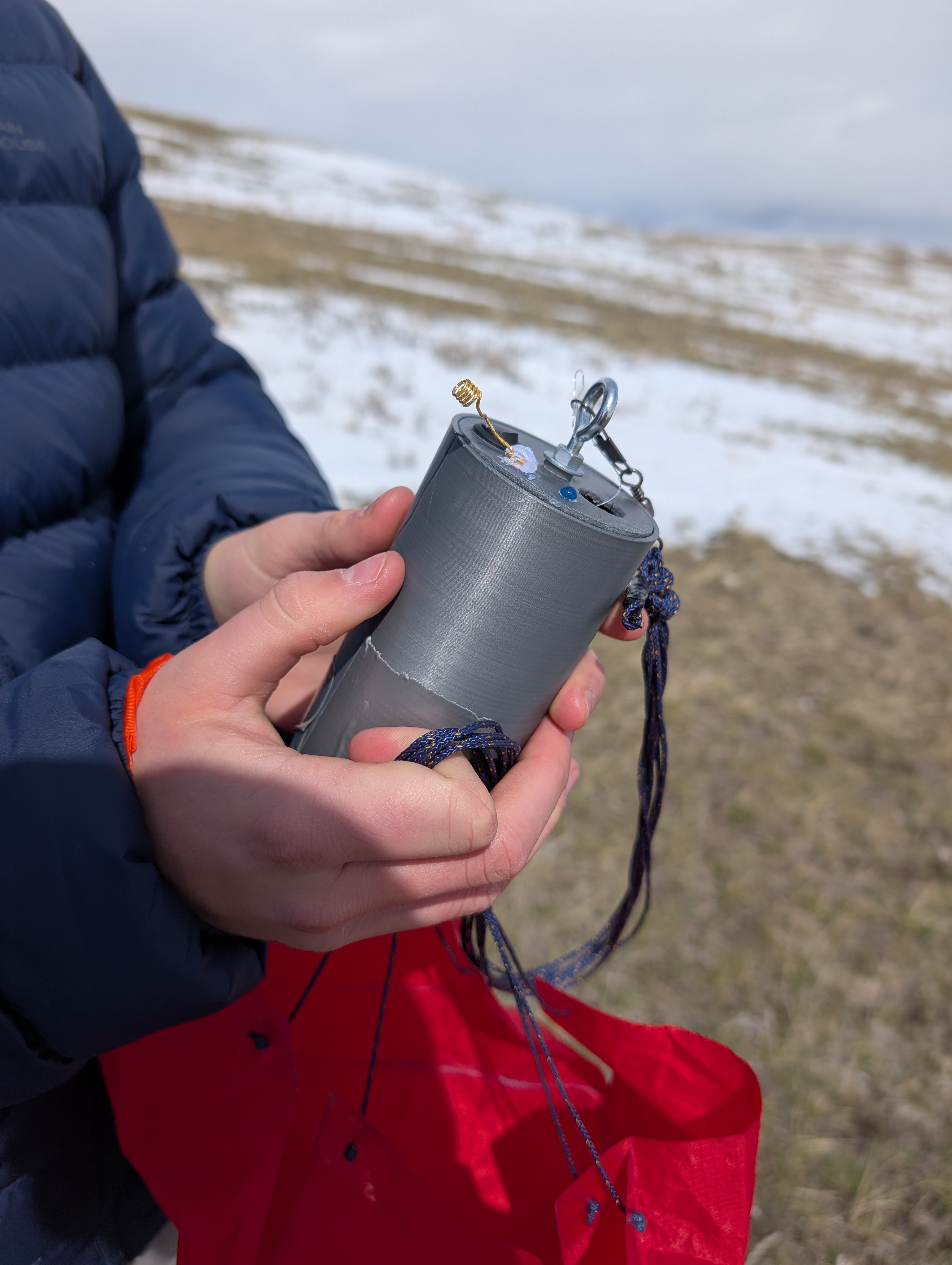
The challenge required students to build a functioning satellite payload that could be launched to an altitude of roughly one kilometre and transmit data back to a ground station during its descent.
Using electronics provided through the competition, students learned to solder components, write computer code, design a satellite housing using 3D printing technology and calculate the size of a parachute that would safely return their creation to Earth.
Each student took responsibility for a different aspect of the project.
“They were really able to diversify their skill sets,” Morson said. “Whether it was outreach, design, coding or the hardware build-up, each person took on a different part of that.”
Inspired by Jasper’s 2024 wildfire, the students chose to focus their project on air quality monitoring. Their satellite carried sensors capable of measuring airborne pollutants and gases associated with wildfire smoke, with the goal of exploring how satellite technology could potentially assist with early wildfire detection.
To strengthen the scientific side of the project, the students consulted experts from the West Central Airshed Society before travelling to Lethbridge.
“I really wanted to commend them on doing that extra legwork,” Morson said. “They wanted to make sure the science was grounded in something real.”
The road to the competition was also supported by students and staff from Harry Collinge High School in Hinton, whose team was attending the same event.
Because both schools are part of the same division, Hinton teacher Hayley Thomas and Morson shared supervision duties during the trip. Harry Collinge students also allowed the Jasper team to benefit from fundraising efforts that helped offset travel expenses.
“The collaboration was really awesome,” Morson said.
After months of preparation, the competition itself brought the kind of challenges engineers often face in the real world.
During final testing in Lethbridge, students spent late nights diagnosing electrical issues and refining their systems. Despite the pressure, Morson deliberately resisted the temptation to take control.
“My whole motivation was to make it the students’ own drive,” he said. “At no point did I take the wheel. This was all their effort.”
The team’s satellite successfully collected and transmitted air quality data for hours leading up to launch day. Then, just as the rocket was loaded onto the launch pad, communications suddenly stopped.
The students initially feared their battery had failed.
Instead, a post-launch inspection revealed a simple but devastating culprit: a power cable had become disconnected when the rocket was moved into position.
“Everything was fine when we walked it over,” Morson said. “But once it got tilted up and settled, that jostle caused the cable to come undone.”
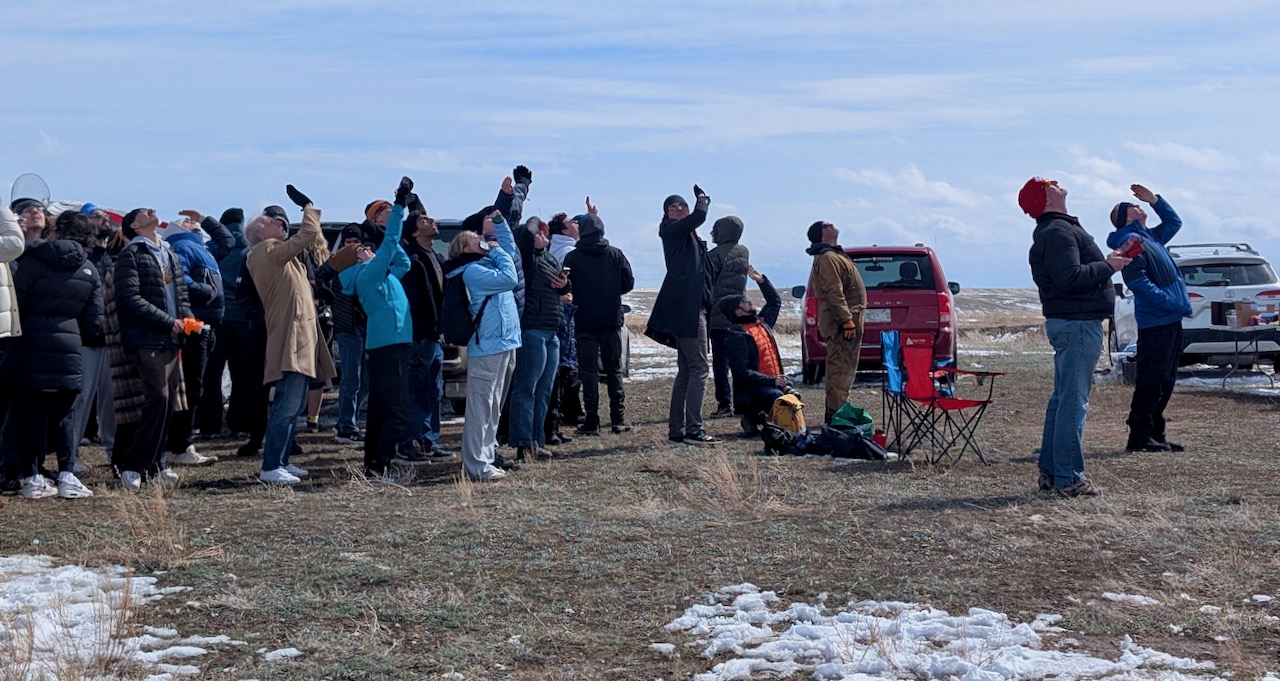
Because of strict launch safety procedures, the team could not access the satellite once it was on the launch pad. All they could do was watch it launch.
The setback was difficult to accept.
“On the way home from launch day they were really bummed,” Morson said.
Yet the students soon realized their project had succeeded in many other ways. Their parachute deployment worked perfectly. Their sensors functioned as intended. Most importantly, they had built a fully operational prototype and learned firsthand how even small oversights can affect a complex engineering project.
“Every single outcome was a learning experience,” Morson said.
The experience has already inspired plans for next year’s participants. The students intend to create a guide documenting lessons learned and practical advice for future teams.
For Morson, one moment stands out above all others.
About two weeks before departure, student Lily Mastrianni approached him with a confident prediction.
“She said, ‘Just so you know, we’re going to have a working satellite,'” he recalled.
That confidence, he said, reflected the determination and ownership the students brought to the project from beginning to end.
“I was really proud,” Morson said. “Getting to that point was all their own steam.”
Bob Covey // bob@thejasperlocal.com